

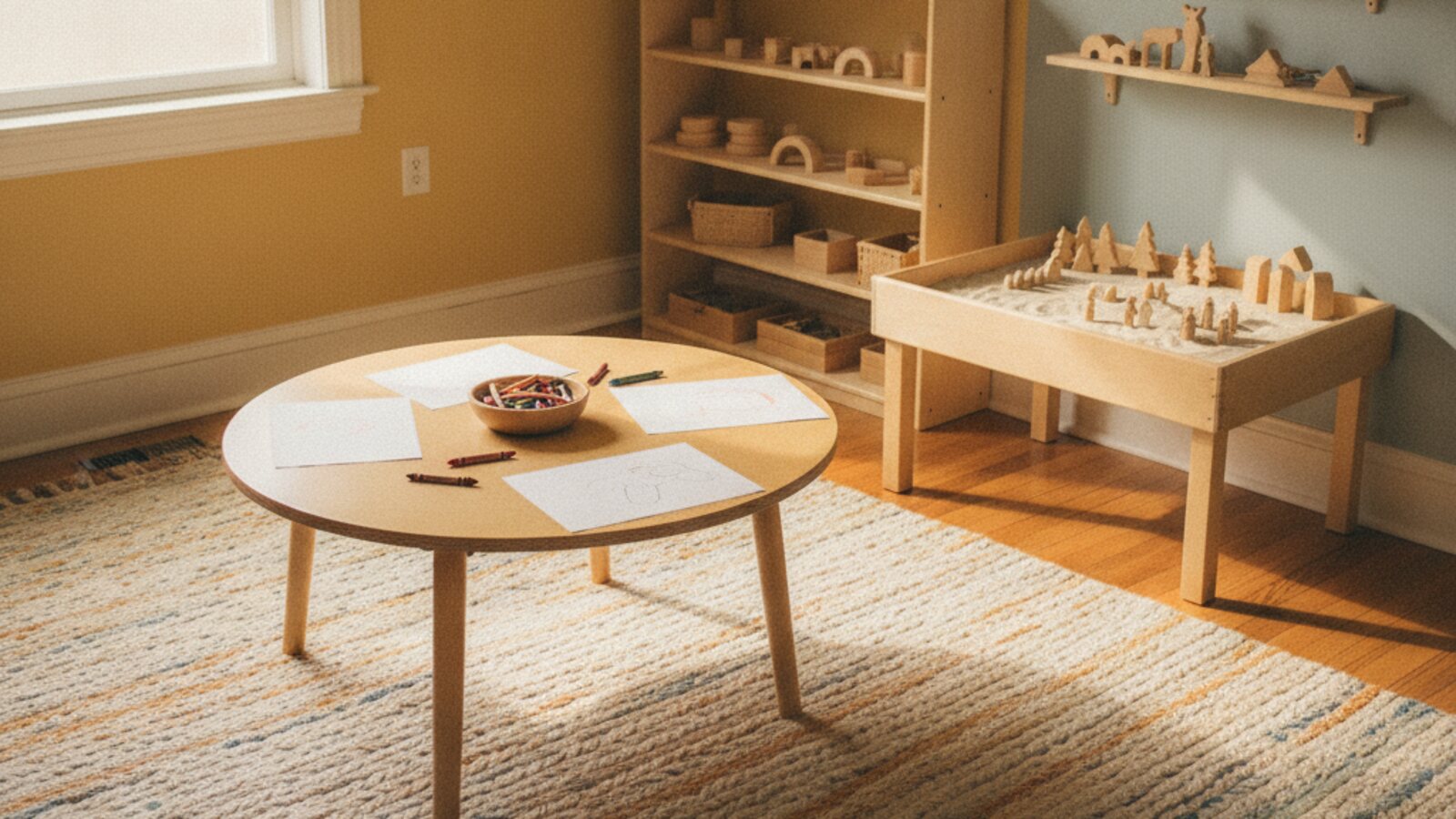
Most parents booking play therapy for the first time have the same unspoken question:
is this therapy, or is my child being kept busy with toys for fifty minutes?
It is a fair question, and the answer is specific enough to be worth setting out.
The Definition
Play therapy has a formal definition, and it is not a vague one. The review *An Overview
of Play Therapy (Koukourikos et al., Mater Sociomed*, 2021) quotes the Association for
Play Therapy's definition as **"the systematic use of a theoretical model that
establishes an interpersonal process, in which trained therapists use the therapeutic
power of play to help children prevent or resolve psychosocial difficulties and achieve
optimal growth."**
Three words in that definition do most of the work. Systematic — it follows a
method, not a mood. Theoretical model — the therapist is working from a framework
that determines what they do and why. Trained — this is a specific competency, not
something that comes automatically with liking children.
Why Play Instead of Talking
This is the part that makes the whole approach make sense, and it is developmental
rather than stylistic.
The same review puts it plainly: **"In contrast to adults, is not an easy task for the
children to express verbally their thoughts, their problems, their questions. They
usually use play to express their concerns, their fears, their desires and to
communicate with their environment." It goes on to note that for "most children
under 11 years the capacity of abstract thinking...is not fully developed."**
Asking an eight-year-old to describe how their anxiety functions, or to explain why they
have started refusing school, is asking for something their development has not yet
equipped them to produce. They are not withholding. The request is simply in the wrong
language.
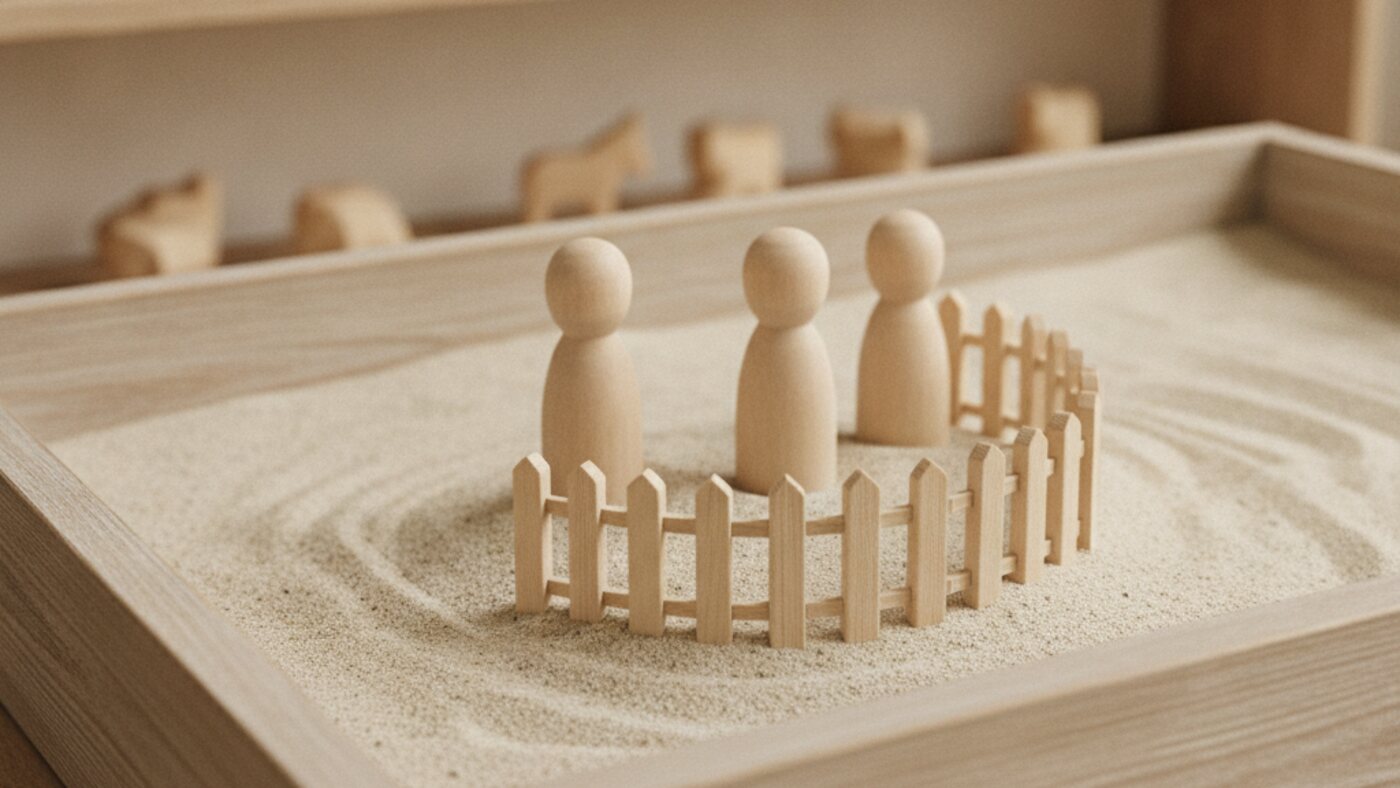
Play is the language they already have. A child who cannot say "I feel powerless when
the adults argue" can readily build a scene where a small figure gets shut in a room and
someone comes to let it out. The content arrives; it just arrives sideways.
The review is also clear on who it suits: play therapy **"as a form of prevention and
treatment is suitable mainly for preschool and school age children."** For older
children and teenagers, the work usually shifts toward talk-based approaches, sometimes
with creative elements retained.
What a Session Actually Looks Like
The room is deliberately equipped: art materials, a sand tray, figures and miniatures,
puppets, building materials, sometimes a dolls' house. The selection is intentional
rather than whatever was on offer.
What the therapist does with it depends on the model. In more non-directive work,
the child leads and the therapist reflects — tracking what is happening, naming feeling,
staying with the child's own narrative without steering it. In more directive work,
the therapist introduces specific activities aimed at a particular difficulty.
Many therapists move between the two depending on the child and the stage of the work.
What it is not: unstructured free time, and not a reward. The therapist is working
throughout — observing themes, noting what recurs, watching what the child avoids,
forming and testing hypotheses about what the play is expressing.
The Parent's Part
Not sure if this is the right fit? Start with a free consultation.
Two things routinely surprise parents.
You will not get a transcript. Children need to know the room is theirs, and a child
who believes everything is reported back will curate what they do in it. What you should
get instead is periodic feedback about themes, progress and what would help at home —
which is genuinely more useful than a play-by-play.
You may be in the room, or you may not. Some models involve parents directly,
particularly with younger children where the relationship itself is part of the work.
Others keep the session as the child's own space. Either is legitimate; ask which
applies and why.
Ask at the start how communication will work, so you are not left guessing.
How to Tell Whether It Is Working
Not from the sessions. Children rarely announce progress, and a child can have a
productive session that looks, from the doorway, like forty minutes of arranging sand.
Look at the ordinary parts of the week instead. Sleep. Mornings before school. How long
it takes to recover from being upset rather than how often it happens. Whether the
things they had stopped doing start coming back. Whether the teacher notices anything.
Progress also is not linear. A temporary increase in difficult behaviour partway through
is common and not automatically a sign the work is failing — it is worth raising with
the therapist rather than concluding from it.
When It Is a Good Fit
Play therapy is generally considered where a preschool or school-age child is struggling
and the difficulty shows up behaviourally rather than in something they can describe:
anxiety, difficulty after a family change, grief, behavioural changes at school, trouble
with regulation, or the aftermath of something frightening.
It is not the answer to everything. A child whose difficulties are primarily
educational, or where a developmental or medical question has not been ruled out, may
need an assessment first or alongside. A good therapist will say so rather than simply
booking sessions.
If You Are Not Sure Where to Start
If you are weighing up whether your child needs
play therapy or whether something else fits better — our
children’s counseling covers a range
of approaches — a first conversation is the fastest way to find out.
A free 15-minute consultation is available, and it is a reasonable place to describe
what you are seeing and ask what would actually help.
If You Need Help Now
If you or your child are in crisis, call or text 988, the Suicide & Crisis Lifeline,
available 24 hours a day. In an emergency, call 911.